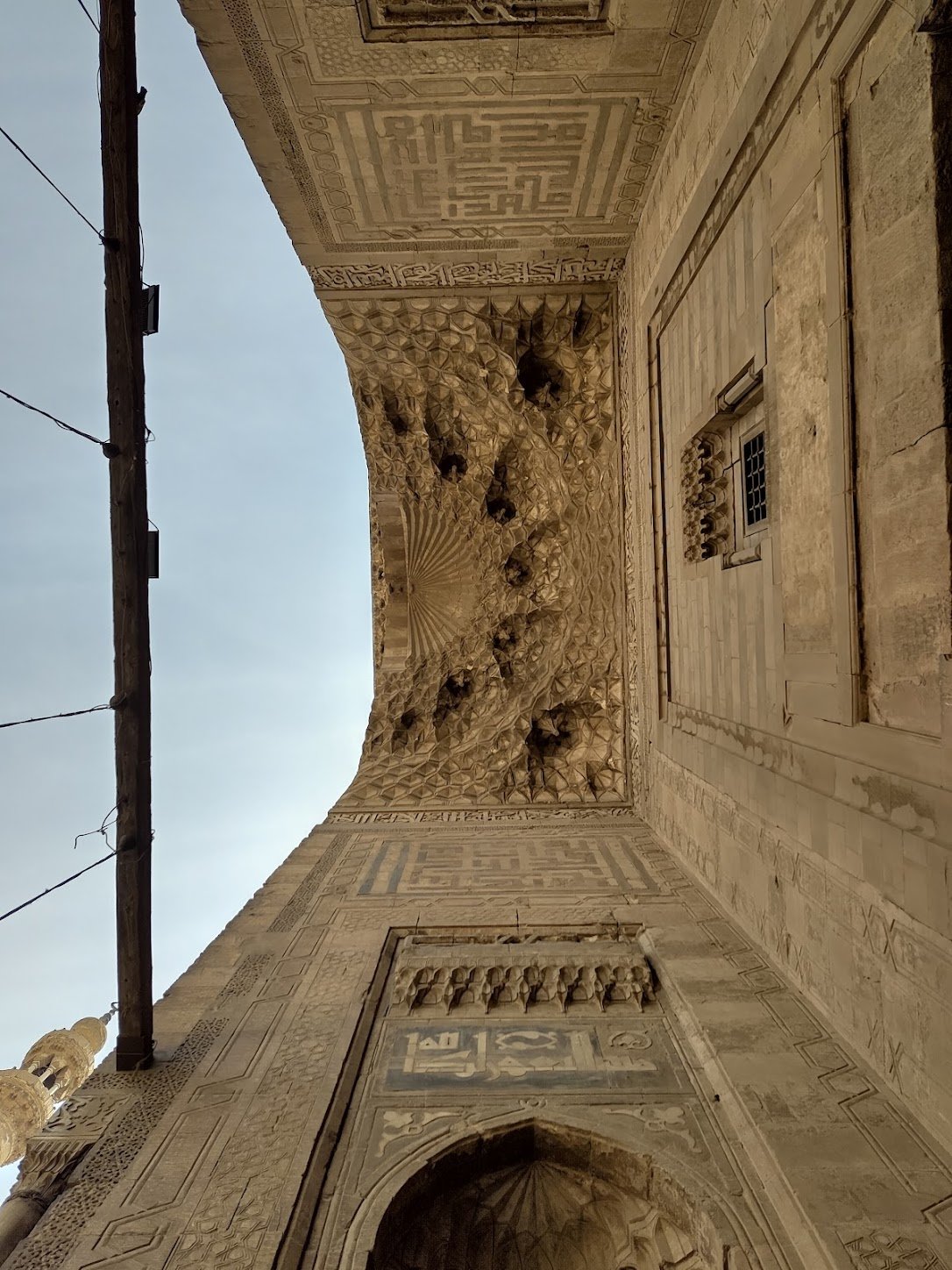
“The main characteristics of acoustic space derive from sound’s essential feature of invoking an unlocalised presence. “Because of its association with sound,” Ong observes, “acoustic space implies presence far more than does visual space.” Sound suggests a presence without location, a presence that occupies the entire space rather than being located in it. This is very much like God’s presence in the qibla of the faithful, which, though physically in front of him, is in reality everywhere around him: “wheresoever you turn, there is the face of God” (2:115).
Acoustic space is not a passive, static space in the sense that its inhabitant adds virtually nothing to its quality; rather, it is an active, dynamic space, “always in flux, creating its own dimensions moment by moment” and always in transformations, corresponding to the states that one may attain during one’s presence in it.”
The characteristics of acoustic space provide an ideal environment for the performance of Islamic prayer, in which every participant is invested with the dignity of the imam...A reported prophetic tradition says that every worshipper is an imam, for the angels pray behind him when he plays alone. Theoretically, every Muslim praying constitutes an independent centre directly connected to the Ka’ba, in the same way that every participant in an acoustic field finds themselves directly related to the sonic source.”
This is a project I started during a residency at Out of the Circle, Cairo, from March 15 to April 4 2026. The residency was funded by the University of Manchester as part of my Hallsworth Fellowship in Geography.
Since my fellowship is concerned with relationships between health, sound and place, I have been exploring the use of creative methods to create and imagine sound maps, and this residency built on that preliminary work. I wanted to develop some methods of mapping sound creatively, as well as critically questioning what a map is, what it does, and what models of mapping I engaged.
Over the three weeks of the residency, I experimented with collaborative zine making, sound/music improvisation, and workshop facilitation to explore different ways of understanding and mapping sound.
At the end of the project, I made a zine about the process that can be read here.